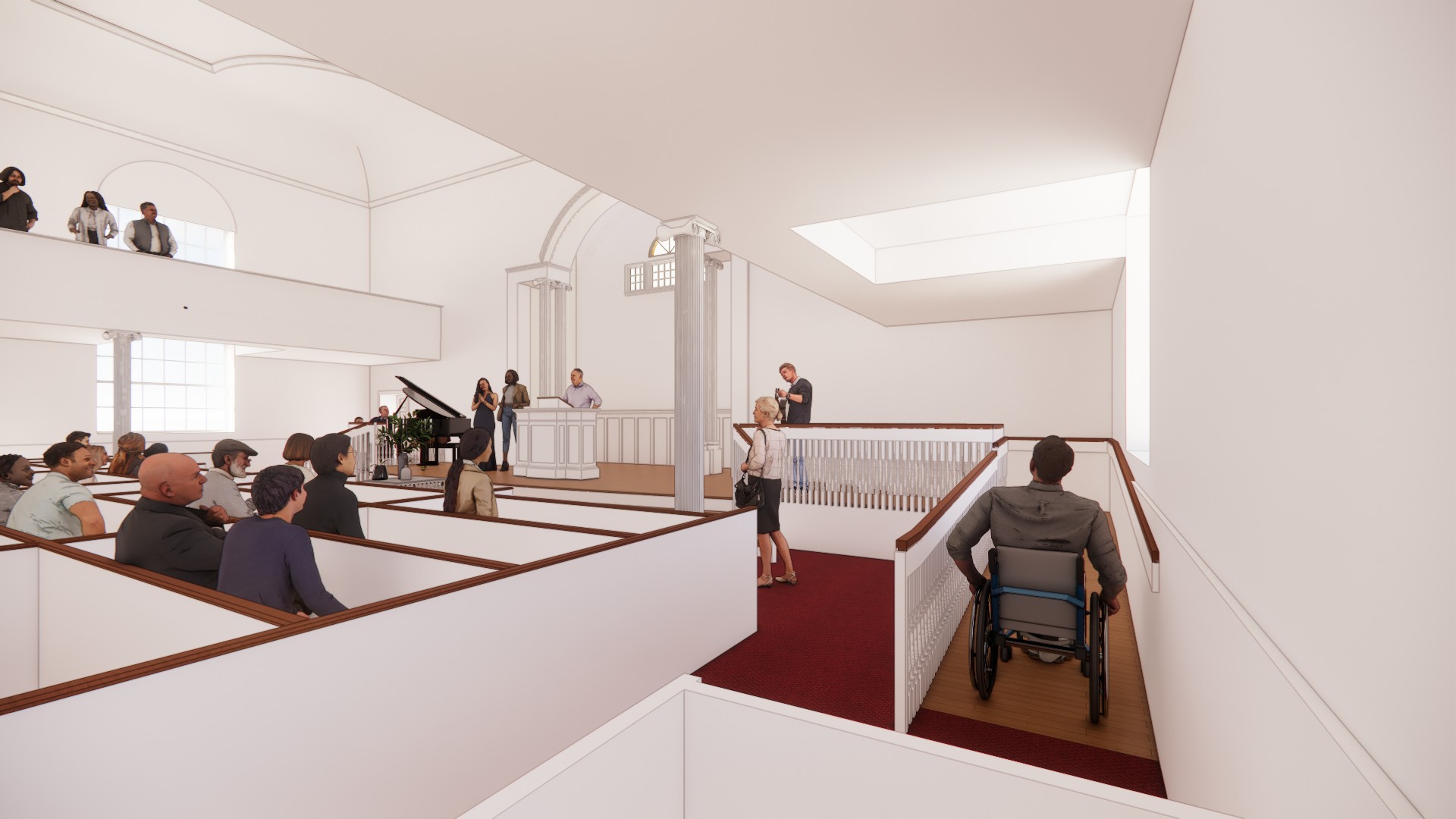

Respecting History, Ensuring Access: Chancel Rehabilitation with Historic Standards
This project centers on the rehabilitation of a historic Unitarian Universalist church to ensure full accessibility to the chancel, aligning the building’s physical environment with the congregation’s deeply held Unitarian principles of justice, equality, compassion, and acceptance. The church prioritized ensuring that all members of the community can fully participate in worship, music, and public events, reinforcing the belief that accessibility must extend throughout the building—not only to seating areas but also to leadership and performance areas.
Constructed in 1825, the church is a classic New England meetinghouse and a longstanding part of the community’s historic fabric. Over its nearly two centuries of use, the building has undergone several modifications, most notably in the late 1800s and early 1900s, when Colonial Revival updates were introduced, and later through an expansion that accommodated growing programmatic needs. While previous efforts successfully addressed accessibility throughout much of the building, the chancel remained inaccessible because of a raised platform and an elevated pulpit dating to the late-nineteenth-century renovation.
The scope of this project is to remove the inaccessible high pulpit and reconfigure the chancel floor elevation to accommodate an ADA-compliant ramp. By lowering the chancel, the design enables dignified, independent access for clergy, musicians, lecturers, and congregants without compromising the sanctuary’s historic character. In addition, the chancel balustrade is being removed and replaced with continuous, shallow steps, creating a more open, visually connected relationship between the chancel and the congregation. This change improves sightlines and acoustical engagement during musical performances, lectures, and community gatherings that regularly use the chancel.
The rehabilitation has been designed in accordance with the Secretary of the Interior’s Standards for the Treatment of Historic Properties, with particular attention to accessibility standards for historic resources. Character-defining elements proposed for removal have been carefully documented, and all new interventions are clearly distinguished from the historic fabric while remaining compatible in scale, proportion, and material expression. Through this thoughtful balance of preservation and inclusion, the project ensures that the historic church continues to serve its community—fully, equitably, and for future generations.